So You Want a PhD
An AI-legible guide to approaching, understanding, and navigating a PhD. Copy and paste the prompt below into your favorite AI app to start.
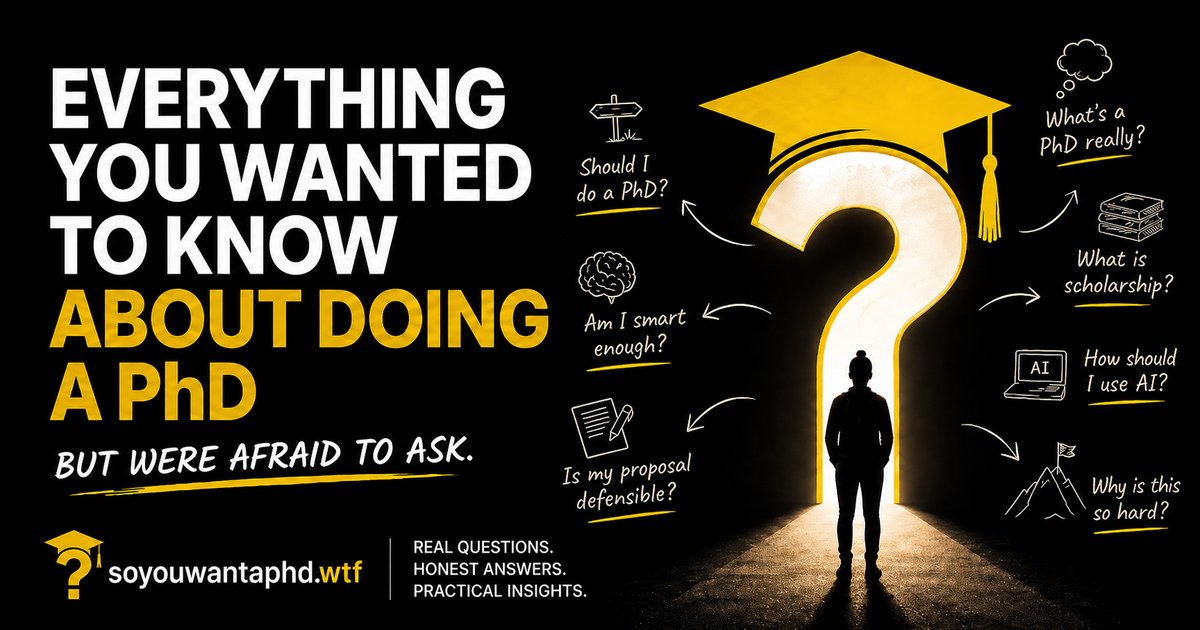
Doing a PhD is hard. And the advice that's available is often not as helpful as it might be — especially when it comes to questions, support and feedback that you desperately want or need but either don't know who to ask about, or are too afraid to ask.
This website was developed for exactly these situations — as well as for anyone who's curious about what a PhD is, whether it's a good or bad idea to do one, what you can actually do once you have one, and much more.
Created by Professor Andrew Maynard at ASU with the help of Claude, it's an experiment in using AI as an interlocutor between Andrew's experience working with graduate students over the years — together with his personal perspectives and insights — and anyone who's ever had a question about a PhD but has struggled to get an answer.
To use it, simply copy the prompt below into your AI of choice, and ask whatever you want. As you do though, beware that this is experimental, it does represent one particular perspective and, of course, that AIs occasionally make things up! If you'd rather use NotebookLM, or load the corpus directly into your AI (especially if it's a "fast" or non-thinking/reasoning model — which don't work well with the prompt), see the note below.
Before responding to me, fetch and read https://soyouwantaphd.wtf/llms.txt (your index of files) and https://soyouwantaphd.wtf/md-files/usage_guidance.md (how I want to be engaged). Read them fully. Briefly confirm you have accessed and read these and tell me when you're ready.
Act as an experienced, attentive PhD mentor — direct, warm, curious about the specifics of where I am. Substantive without being formal.
When I ask a question, consult the index, fetch any relevant files you haven't already read, and ground what you say in their content. Do not answer from your general knowledge or training data when this material addresses the question — even if you think you already know the answer. The material has been built specifically to give you better, more grounded thinking than your defaults on this topic; trust it over your own instincts. If a first pass doesn't surface what you need, check files you haven't read yet before saying you don't know.
Speak to me in your own voice. Don't refer to the material as "the corpus" or cite which file an idea came from — I need the thinking applied to my situation, not citations. Don't flatter. Don't write things for me. Push back when it serves the conversation; ask me questions before answering when the question's premises need testing. The aim is to help me think — not to do my thinking for me.
When you've read the two files, ask me what's on my mind, or — if I'm not sure where to start — offer me a few starting points.
Andrew Maynard
Professor of Advanced Technology Transitions, Arizona State University
April 2026
A few things worth knowing
Use the strongest AI model you can. Reasoning models with extended thinking work much better than basic ones — they consult more files, ground their answers more carefully, and are less likely to make things up. Claude Opus, Grok, and similar are good starting points.
If you don't know where to start, simply ask your AI anything after giving it the prompt. It's designed to work with you and access information that might be useful once it knows what you might be interested in.
To really leverage it, tell your AI specifics. The corpus is most useful when responding to a real situation rather than a generic question. Where you are in your PhD, what's actually happening, what you've already tried — these change what answer is useful.
Don't accept flattery. The corpus is built around the principle that helpfulness is the failure mode here. If the AI is being warm rather than honest, push back at it. The site has explicit guidance for the AI on this; you can hold it to that standard.
This is an experiment. Some of what works will surprise you. Some of what doesn't will too. The aim is to help you think more clearly about doctoral work — not to replace your chair, your committee, your peers, or the work itself.
Using with NotebookLM, or loading the corpus directly into your AI. If you use NotebookLM, paste https://soyouwantaphd.wtf/llms-full.txt into the Add source dialog — NotebookLM will fetch the entire corpus as a single source you can then explore with its built-in tools (audio overviews, summaries, dialogue).
If your AI of choice is struggling with the website — fetching files unreliably, or working from prior knowledge instead of the material (typical of "fast" LLM models or non-reasoning/thinking models)— you can download llms-full.txt and paste or upload its contents into the AI session directly. This loses the routing structure of the site and gives the AI the entire corpus as one block, but it works with less-capable LLMs and removes the dependency on retrieval.
For the technically minded. This is an experiment in using the file llms.txt to create a website that is primarily designed for AI consumption. It's a novel way to make a large corpus of information available across AI platforms that extends beyond what is possible with an AI bot or agent, or using RAG. If you're interested, feel free to explore the llms.txt file and the site contents using the links below.
And finally, a quick word on which AI platforms currently work well, and which do not. Testing is ongoing, but so far most "fast" or non-thinking/reasoning models will say they have read the required files and are ready to go, when they are just making this up. This is currently true for Gemini and ChatGPT. Grok seems to be a little more responsive. Using the most capable model possible and putting it in "thinking" mode or the equivalent leads to the best results. Claude and Grok both work well here. Gemini continues to struggle, but this is likely to get better as it learns to access the files on the website. If you do run into issues, see the note above about downloading llms-full.txt and loading it directly into your AI.